
Armour & Chainmail for Re-enactment & LARP
Armour and chainmail for living history, re-enactment, LARP and stage or screen work, from a single coif to a full harness.
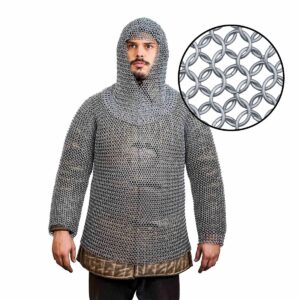
The mail covers from head to thigh. There are plain and V-face coifs, a gorget collar, a wedge-riveted aventail for lacing to a helm, half-sleeve haubergeons, full-sleeved hauberks and a Roman lorica hamata. Most of it is 16-gauge mild steel in 10 mm round butted rings, blackened or zinc-plated. Where you want a harder-wearing shirt, there's 16-gauge high-tensile spring steel in 9 mm rings.
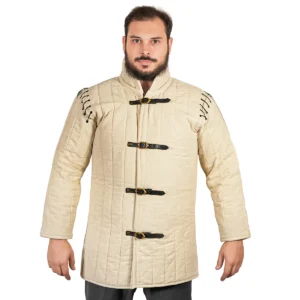
The padded armour that goes underneath includes quilted cotton-canvas gambesons, arming doublets, caps, collars, and hoods, several of which are from Lord of Battles, which Battle Worlds stocks in the UK.
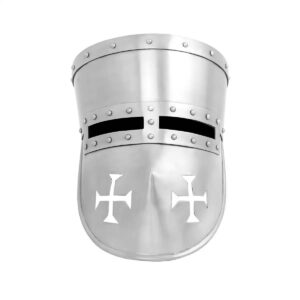
The plate includes helms, a riveted-plate brigandine, and stands to hang them on. Mail should never sit on bare skin, so arm from the inside out, and take your measurements over the padding you'll actually wear (see the sizing guide).
After every outing, wipe the steel dry, give it a thin coat of oil, and keep it out of plastic bags, where damp gets trapped against the rings.
Arming Notes
Butted or riveted mail?
In butted mail, each ring's ends are pressed together but not joined, which makes it quicker to make. Under a hard blow, the rings can spring open. In riveted mail, each ring is closed with a rivet, so it holds together under rougher use. Most of the mail here is butted. The aventail is wedge-riveted.
What order do I put it on?
Work from the inside out. Put on an arming cap, then the coif, then the helm. For the body, a gambeson or arming doublet goes on first, then the hauberk or haubergeon over it. Measure over the padding, not over your shirt.
Which steel and gauge do I need?
16-gauge mild steel with 10 mm butted rings suits display, living history, stage and LARP costume. 16-gauge high-tensile spring steel with 9 mm rings holds its shape better under wear. The butted mail in this range isn't sold as combat-rated protection. Before you take any piece into steel combat, read its notes and check your group's armour rules.
How do I look after it?
Dry it, oil it, and store it somewhere with air around it. Light surface rust comes off with fine wire wool and a little oil. Full instructions are on the care and maintenance page.